
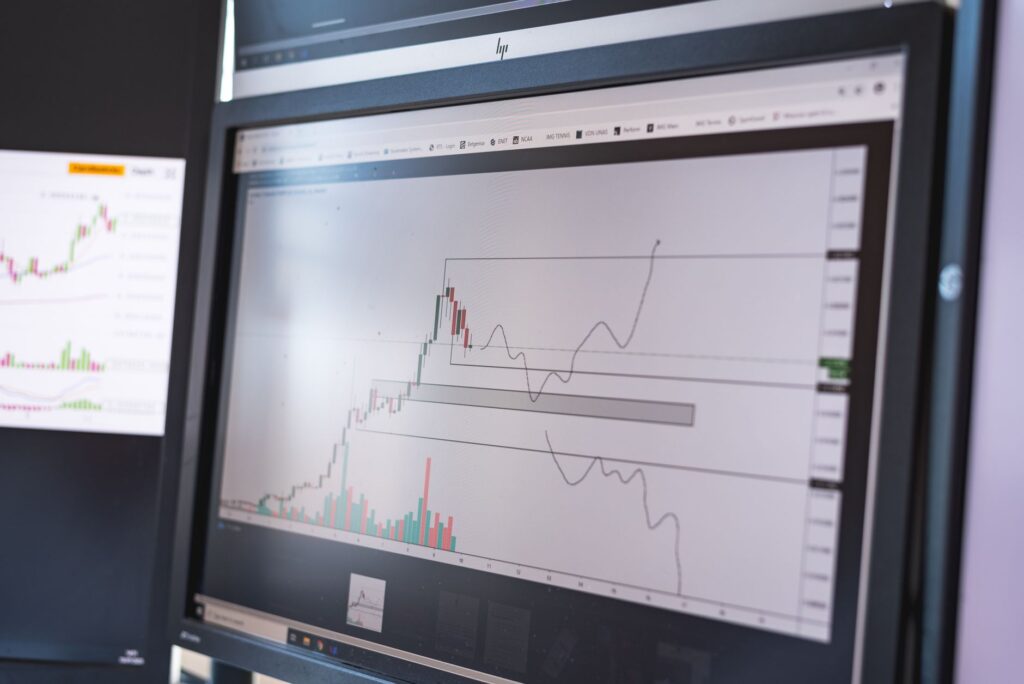
Crypto trading for beginners is best learned slowly, with small amounts and clear rules. Trading means buying and selling digital assets to profit from price moves, rather than simply holding for the long term. It can be exciting, but it is also one of the fastest ways to lose money if you skip the basics. This guide explains how crypto markets work, the order types and tools you will use, how to manage risk, and the mistakes that catch almost every new trader. Most importantly, it is honest about the odds: the majority of active traders underperform a simple buy-and-hold strategy.
Key takeaways
- Trading aims to profit from short- to medium-term price moves; investing aims to hold quality assets for years.
- Most active retail traders underperform a basic buy-and-hold approach after fees and mistakes.
- Risk management — position sizing and stop-losses — matters more than picking the “right” coin.
- Start with paper trading and tiny real positions before risking meaningful money.
- No method predicts the future; everything is probabilities, so protect your capital first.
Trading vs. investing: know which one you are doing
Before placing a single order, decide whether you are trading or investing, because the two require different mindsets. An investor buys an asset they believe in and holds through volatility, often using dollar-cost averaging to smooth out entry prices over months or years. A trader tries to capture shorter moves — minutes, days, or weeks — and accepts that they will be wrong frequently.
Many beginners blur the line: they buy intending to invest, panic during a dip, sell, then chase the next pump. That confused behavior produces the worst outcomes. Pick a lane for each position and write down your plan before you click buy. If your real goal is long-term exposure, a steady accumulation strategy is usually simpler and historically more reliable than active trading.
How crypto markets work
Crypto trades 24/7, with no opening or closing bell, across hundreds of exchanges worldwide. Prices are set by supply and demand in an order book — a live list of buy orders (bids) and sell orders (asks). When a buyer and seller agree on a price, a trade executes. The difference between the highest bid and lowest ask is the spread, an implicit cost you pay on every trade.
Liquidity describes how easily you can buy or sell without moving the price. Large assets like Bitcoin and Ethereum are highly liquid; small coins can be thin, meaning a modest order can swing the price sharply. Understanding an asset’s size helps here — see our explainer on market cap to judge how established a coin really is. Thin, low-cap coins are where beginners most often get trapped by volatility and slippage.
Spot vs. derivatives
Spot trading means buying the actual coin and owning it. Derivatives like futures let you trade on price with leverage — borrowed money that multiplies both gains and losses. Leverage is the single biggest reason beginners blow up accounts. As a new trader, stick to spot. Leveraged and margin products can liquidate your entire position on a routine 10% move, which crypto delivers regularly.
Order types you need to understand
Most exchanges offer a handful of core order types. Learning them prevents costly mistakes.
- Market order: buys or sells immediately at the best available price. Fast, but on illiquid coins you may get a worse price than expected (slippage).
- Limit order: executes only at your specified price or better. You control the price but may not get filled.
- Stop-loss: triggers a sell once price falls to a level you set, capping a loss.
- Take-profit: triggers a sell once price rises to a target, locking in a gain.
A disciplined trader almost always defines a stop-loss and a take-profit before entering. This removes emotion from the exit, which is where most damage happens.
Risk management: the part that actually matters
Beginners obsess over entries and ignore risk. Reverse that. You cannot control whether a trade wins, but you can control how much you lose when it fails. Two rules do most of the work.
1. Position sizing
Decide in advance the maximum you will lose on any single trade — a common guideline is 1% to 2% of your trading capital. From that, and your stop-loss distance, you calculate position size. If you risk 1% and your stop is 10% below entry, your position should be about 10% of your account. This math means a string of losses won’t wipe you out.
2. The risk-reward ratio
Only take trades where the potential reward justifies the risk. If you risk $100 to make $200, that’s a 1:2 ratio. With 1:2, you can be wrong more often than right and still come out ahead. Trades with poor risk-reward — risking a lot to make a little — are how accounts bleed slowly.
Never trade money you need for rent, bills, or an emergency fund, and never use borrowed money. For context on how crypto’s risk profile compares to traditional markets, see crypto vs. stocks.
Technical vs. fundamental analysis
Traders use two broad toolkits. Technical analysis (TA) studies price charts and indicators to estimate probable future moves. Fundamental analysis evaluates a project’s technology, team, adoption, and tokenomics to judge long-term value.
A crucial caveat: technical analysis is probabilistic, not predictive. A “bullish” pattern does not guarantee a rise; it suggests one outcome has been slightly more likely historically, and it fails often. Treat TA as a way to manage probabilities and define risk, not a crystal ball. If you want to start learning charts, our guide on how to read crypto charts covers the foundations.
A simple step-by-step start
- Educate first. Learn order types, risk sizing, and basic chart reading before depositing money.
- Paper trade. Practice with a simulator. Crypto paper trading lets you test a strategy with fake money and real prices, so mistakes cost nothing.
- Choose a reputable exchange. Compare fees, security, and supported assets — our best crypto exchange roundup is a starting point.
- Fund a small account. Start with money you can fully afford to lose.
- Trade liquid assets only. Stick to large-cap coins while you learn.
- Journal every trade. Record your reason, entry, stop, target, and outcome. Reviewing this is how you actually improve.
Building a plan, not chasing tips
A trading plan is a written set of rules: which assets you trade, your timeframe, entry criteria, position size, stop-loss rules, and profit targets. Without one, you are gambling. With one, you can measure whether your edge is real.
Trading should also fit inside a broader plan for your money. Most people are better served keeping the bulk of their crypto in a long-term portfolio strategy and treating active trading as a small, ring-fenced experiment. That way a bad trading streak doesn’t derail your overall finances.
Common beginner mistakes
- Using leverage too soon. It magnifies losses and triggers liquidations on normal volatility.
- No stop-loss. Hoping a loser recovers is how small losses become catastrophic ones.
- Over-trading. Frequent trades rack up fees and emotional fatigue. Fewer, higher-quality setups win.
- FOMO and revenge trading. Chasing green candles or trying to “win back” a loss leads to impulsive, oversized bets.
- Risking too much per trade. One bad trade should never threaten your account.
- Trusting bots blindly. Automated tools have a place, but they are not free money — read our take on crypto trading bots before relying on one.
Should you trade at all?
Be honest with yourself. Active trading is demanding, time-consuming, and statistically tough — the data consistently shows most retail traders lose to a simple hold strategy after fees and taxes. There is no shame in deciding that patient accumulation suits you better. If you do trade, start tiny, manage risk relentlessly, and judge yourself over dozens of trades, not one lucky win.
FAQ
How much money do I need to start crypto trading?
You can start with very little, since you can buy fractional amounts of most coins. The right question is how much you can afford to lose entirely. Many beginners start with a small amount they would not miss while they learn the mechanics and test their plan, scaling up only after consistent, risk-managed results.
Is crypto trading profitable for beginners?
It can be, but the odds are against you early on. Studies of retail traders across markets show most underperform a buy-and-hold approach after fees, slippage, and emotional errors. Treat your first months as paid education, focus on not blowing up, and measure progress over many trades rather than individual wins.
What is the safest way to practice trading?
Paper trading. Using a simulator with real-time prices and fake money lets you rehearse entries, stops, and exits with zero financial risk. Once you are consistent on paper, move to very small real positions. The psychology of risking real money differs, so transition gradually rather than jumping straight to a large account.
Should beginners use leverage?
No. Leverage multiplies losses as well as gains and can liquidate your position on a routine price swing, which crypto delivers often. New traders should trade spot only — buying the actual asset with their own funds. Master risk management and consistency first; most experienced traders still avoid high leverage entirely.
Crypto is volatile and risky; this is education, not financial advice. Do your own research.